Captures and Immediate Aftermath for Allied Forces and Civilians
The Philippines
The Japanese invasion of the Philippines began on December 8, 1941, shortly after Pearl Harbor, with landings at Lingayen Gulf and subsequent advances southward. Allied forces, primarily American and Filipino troops under U.S. command, retreated to the Bataan Peninsula for a defensive stand. After a grueling three-month Battle of Bataan, marked by shortages of food, medicine, and ammunition, Major General Edward P. King surrendered on April 9, 1942. This resulted in the capture of approximately 72,000 to 78,000 POWs, including about 66,000 Filipinos and 12,000 Americans. Official Japanese reports cited at least 9,000 American soldiers, sailors, and marines captured, along with 30,000 Filipinos. While the focus was on military personnel, over 38,000 civilian noncombatants were caught in the crossfire during the battle, though specific details on their systematic capture are limited; some were displaced or interned as the Japanese consolidated control.
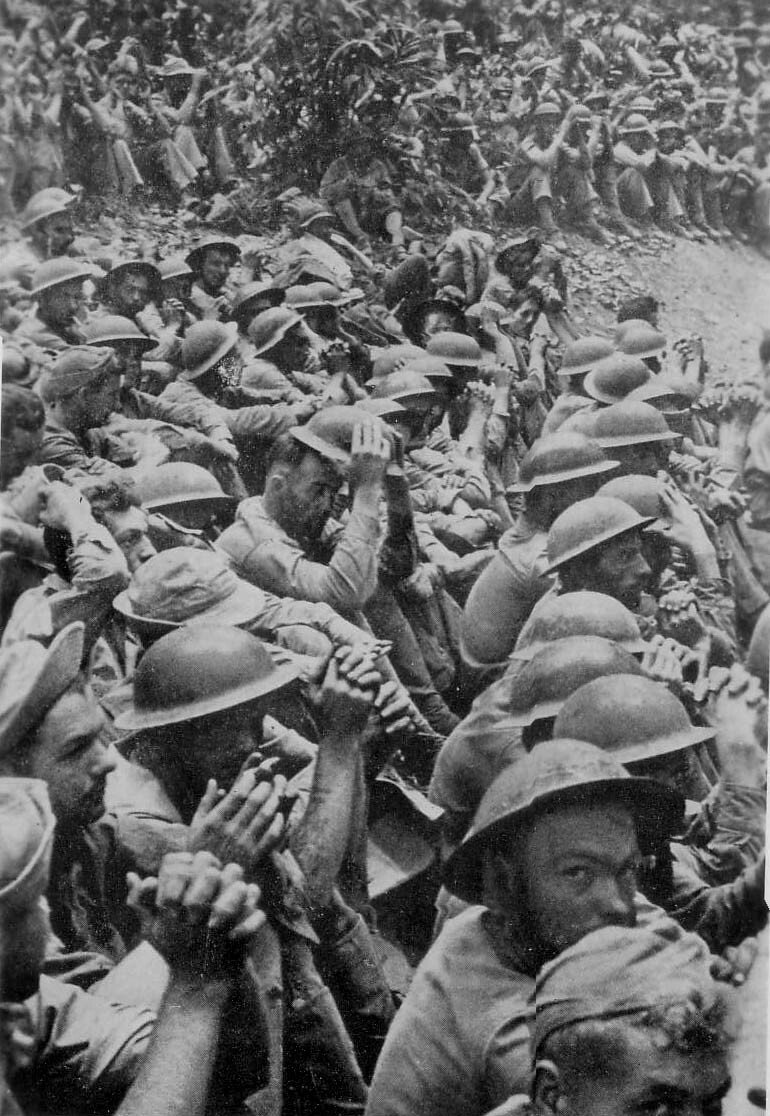
Immediately after surrender, the POWs were assembled in Mariveles and Bagac on the southern tip of Bataan. Deprived of their possessions and grouped into units of about 100 under Japanese guard, they were forced into the infamous Bataan Death March, a 65-mile (105 km) trek northward to San Fernando, Pampanga, lasting from April 9 to 17, 1942. The march was characterized by extreme brutality, as Japanese soldiers, influenced by their own hardships and cultural disdain for surrender, subjected prisoners to physical abuse, starvation, and dehydration. POWs marched empty-handed while guards carried heavy equipment, receiving minimal food (often just a rice ball) or water. Those who collapsed were beaten, bayoneted, or shot; trucks sometimes ran over the fallen, and “cleanup crews” executed the weak. Torture methods included the “sun treatment,” where prisoners sat unprotected in scorching heat, or were denied water near sources. The Pantingan River massacre saw up to 400 Filipino officers and NCOs executed on orders from Colonel Masanobu Tsuji. Casualties were staggering: estimates range from 5,000 to 18,000 Filipino deaths and 500 to 650 American deaths during the march alone.
From San Fernando, survivors were crammed into unventilated metal boxcars—100 or more per car—in 43°C (110°F) heat for a rail journey to Capas, Tarlac, where many suffocated or died from disease. They then walked an additional 9 miles (14 km) to Camp O’Donnell, a former Philippine Army training ground converted into a POW camp starting around April 1, 1942. Of the roughly 80,000 who started the march, only about 54,000 reached O’Donnell, where conditions worsened: overcrowding, malnutrition, and disease led to hundreds of deaths daily, totaling up to 20,000 Filipinos and Americans in the initial months. Bodies were buried in mass graves behind barbed wire. By early May, the camp held around 9,300 American POWs. Many survivors were later transferred to other nearby camps like Cabanatuan (a major consolidation site) or Bilibid Prison in Manila, where they faced forced labor details, further abuse, and high mortality from dysentery and malaria. Some escaped during the march but were recaptured, while others joined guerrilla forces. Civilian internment in the Philippines was less centralized initially, with some Europeans and Americans rounded up in Manila and held in places like Santo Tomas University, but the immediate post-capture period for them involved house arrests or hasty relocations amid the chaos.
Southeast Asia (Primarily Malaya and Singapore)
The Japanese campaign in Southeast Asia targeted British-held Malaya and Singapore, beginning with landings in northern Malaya on December 8, 1941. Allied forces, including British, Australian, Indian, and local troops under Lieutenant-General Arthur Percival, numbered around 85,000 but were hampered by poor coordination, inexperience, and Japanese air superiority. The Battle of Singapore culminated from February 8 to 15, 1942, with Japanese troops under General Tomoyuki Yamashita (about 36,000 strong) outflanking defenses and capturing the island. On February 15, Percival surrendered unconditionally, leading to the capture of approximately 80,000 Allied troops—38,000 British, 18,500 Australian, 67,300 Indian, and 14,400 local volunteers—plus 50,000 previously taken in Malaya.
Post-surrender, the troops were disarmed and rounded up, with initial treatment varying: British personnel were briefly allowed a small armed contingent to prevent looting until Japanese forces arrived. However, brutality soon ensued, including beatings, starvation, and overcrowding in temporary holding areas. No large-scale forced march like Bataan’s occurred, but prisoners endured short, harsh treks to collection points amid disease and inadequate provisions. For the first few days, there were no Japanese guards at some sites, but patrols began within two weeks. Many were transferred to Changi Prison and nearby Selarang Barracks on Singapore’s east coast, which became the primary POW camp. Designed for far fewer inmates, Changi held up to 50,000 POWs in overcrowded cells, workshops, and corridors, with conditions including malnutrition, forced labor, and disease leading to about 850 deaths. Women and children were separated; around 500 women and girls marched to the prison, where they sewed quilts under duress. POWs from other regions, like Americans from the USS Houston and the 131st Field Artillery (captured in Java), were also funneled to Changi.
Civilians faced severe reprisals. Ethnic Chinese in Singapore endured the Sook Ching massacre starting February 18, with 31,000 to 57,000 males killed through purges and terror tactics to enforce submission. European civilians, including British and Dutch, were interned in camps like Changi or Sime Road, subjected to similar hardships. Many POWs were soon shipped out for forced labor on the Burma-Thailand Death Railway or to Japan on “hell ships,” with high mortality en route. About 40,000 Indian POWs joined the Japanese-aligned Indian National Army.
Indonesia (Dutch East Indies)
The Japanese targeted the resource-rich Dutch East Indies (modern Indonesia) starting December 1941, with landings in Borneo, Celebes, and Sumatra. Allied forces under ABDACOM—about 40,000 Dutch, 8,000 Anglo-American troops, and local forces—were outnumbered and outmaneuvered. Key battles included Tarakan (January 11, 1942), Balikpapan, and the naval clashes at Java Sea (February 27) and Sunda Strait, resulting in heavy Allied losses: 24 ships sunk, 5,000–10,000 killed, and thousands captured. The campaign ended with the unconditional Dutch surrender on March 8–9, 1942, at Kalijati Airfield in Java, led by Lieutenant General Hein ter Poorten and Governor General Alidius Tjarda van Starkenborgh Stachouwer. Over 100,000 Allied personnel were captured across the archipelago, exhausted from relentless air attacks. Guerrilla resistance persisted in Timor until 1943.
No major forced marches are documented, but captures were rapid and chaotic, with troops rounded up after local surrenders on islands like Java, Sumatra, and Borneo. Immediate treatment involved disarming and temporary holding in overrun positions, followed by transport to camps amid abuse and deprivation. Civilians were heavily affected: an estimated 125,000 were interned, the largest group from the Dutch East Indies, including 100,000 Europeans and some Chinese, with death rates of 13–30% in camps. Camps were scattered across Java (e.g., Semarang, Magelang, Soerabaja), Sumatra, Borneo, and eastern islands, with harsh initial conditions like overcrowding and arbitrary detention under military administration. Atrocities included the Bangka Island massacre on February 16, 1942, where 23 Australian nurses (survivors of a shipwreck) were herded into the surf and machine-gunned, leaving only one survivor. Many POWs, including Dutch like those from the Royal Netherlands Indies Army (KNIL), were shipped to Singapore’s Changi or Japan for labor, with camps like Fukuoka receiving groups from the Indies. The occupation lasted until 1945, with internees facing ongoing forced labor and high mortality.
South Pacific Islands
Guam (Mariana Islands)
The Japanese invasion of Guam, a U.S. territory, commenced on December 8, 1941 (Guam date), coinciding with the Pearl Harbor attack, through aerial bombings of military facilities. On December 10, approximately 5,500 Japanese troops from the South Seas Detachment landed at multiple sites including Tumon Bay, Hagåtña, and Merizo. The small U.S. garrison—consisting of about 400 Marines, Navy personnel, and Guam Insular Force Guards—offered limited resistance due to inadequate defenses and armament. Naval Governor George J. McMillin surrendered unconditionally around 7:00 a.m. on December 10, resulting in minimal combat casualties: 17 Americans killed (including some post-surrender) and about 30 wounded, versus one Japanese killed and a few wounded.
Approximately 483 Americans were captured as POWs, including 368 military personnel (U.S. Navy, Marines, and local guards), five female nurses, and around 115 civilians (businessmen, Catholic priests, and others, including the Spanish Bishop Miguel Olano). These prisoners were initially interned in Hagåtña at the Saint Vicente de Paul building or similar facilities. Treatment immediately post-capture involved disarmament, searches, and confinement under guard, with reports of some beatings and one documented post-surrender killing (Private First Class John Kauffman). Within weeks (by January 1942), most were transported by ship to POW camps in Japan, primarily Zentsûji in Kagawa Prefecture (and later branches like Kobe), where conditions were relatively better than many camps as it was showcased to the International Red Cross, though still involving forced labor and malnutrition.
The indigenous Chamorro population (about 21,500 of Guam’s 23,400 residents) and other civilians were not systematically captured as POWs but subjected to immediate occupation controls. Japanese authorities released pre-war Japanese residents from U.S. detention and imposed martial law. Civilians remained on their farms initially, but faced requisitions of property, forced learning of Japanese language and customs (including bowing and renaming places), bans on English, and currency changes to the yen. No large-scale forced marches occurred right after capture, but early hardships included arbitrary arrests, interrogations, and exploitation of labor for fortifications. As the war progressed (especially 1944 ahead of U.S. recapture), atrocities escalated: forced marches to concentration camps like Manenggon (lacking food, shelter, or sanitation), rapes, beatings, torture, beheadings, and summary executions, resulting in around 1,000–2,000 civilian deaths over the 31-month occupation. Some Chamorros aided hidden American evaders like George Tweed, leading to reprisals.
Wake Island
Wake Island, a remote U.S. outpost with ongoing airfield construction, faced Japanese air raids starting December 8, 1941. A small garrison—449 Marines (1st Defense Battalion detachment), 68 Navy personnel, 5 Army communicators, and about 1,150 civilian contractors (Morrison-Knudsen employees), plus 45 Chamorro Pan Am workers—repulsed the first invasion attempt on December 11, inflicting heavy Japanese losses. However, relentless bombings depleted defenses, and a reinforced Japanese force (about 1,000–2,000 troops) landed on December 23. After fierce fighting, Commander Winfield S. Cunningham surrendered that afternoon to avoid futile losses, capturing approximately 1,616 Americans (368 Marines, 60 Navy, 5 Army, and 1,183 civilians, including Chamorros).
Immediately after surrender, prisoners were disarmed, assembled on the airfield, and seated under machine-gun guard. Reports describe initial brutality: blindfolding threats, beatings, and torture for information. Some resisted or hid briefly, but most complied after destroying usable equipment. Five executions occurred en route during transport. Most military POWs and many civilians were soon shipped to camps in China (e.g., Shanghai) and Japan (e.g., Fukuoka, Woosung), enduring starvation, disease, torture, and forced labor; survivors were liberated in 1945.
About 98–100 American civilian contractors remained on Wake for forced labor, fortifying the island under harsh conditions (minimal food, beatings, and exposure). No immediate mass marches, but daily abuse and exploitation. In July 1943, one was beheaded for stealing food. On October 7, 1943, following U.S. carrier raids (October 5–6), Rear Admiral Shigematsu Sakaibara ordered their execution fearing invasion: the 98 were blindfolded, bound, marched to an anti-tank ditch on the north end, and machine-gunned; survivors were bayoneted. One escaped temporarily, carving “98 US PW 5-10-43” on a coral rock before recapture and beheading. This massacre, one of the war’s brutal episodes, led to postwar convictions (Sakaibara hanged in 1947).
The 45 Chamorro Pan Am employees from Guam were also captured; most survived transfer to camps in Japan/China, later recognized as veterans.
These isolated captures contrasted with larger campaigns, featuring quick surrenders due to overwhelming odds, followed by POW transfers or on-site labor/exploitation rather than death marches. Civilian suffering, especially for locals on Guam, intensified over the occupation.
Exactly how many Allied military personnel and civilians became POWs and internees?
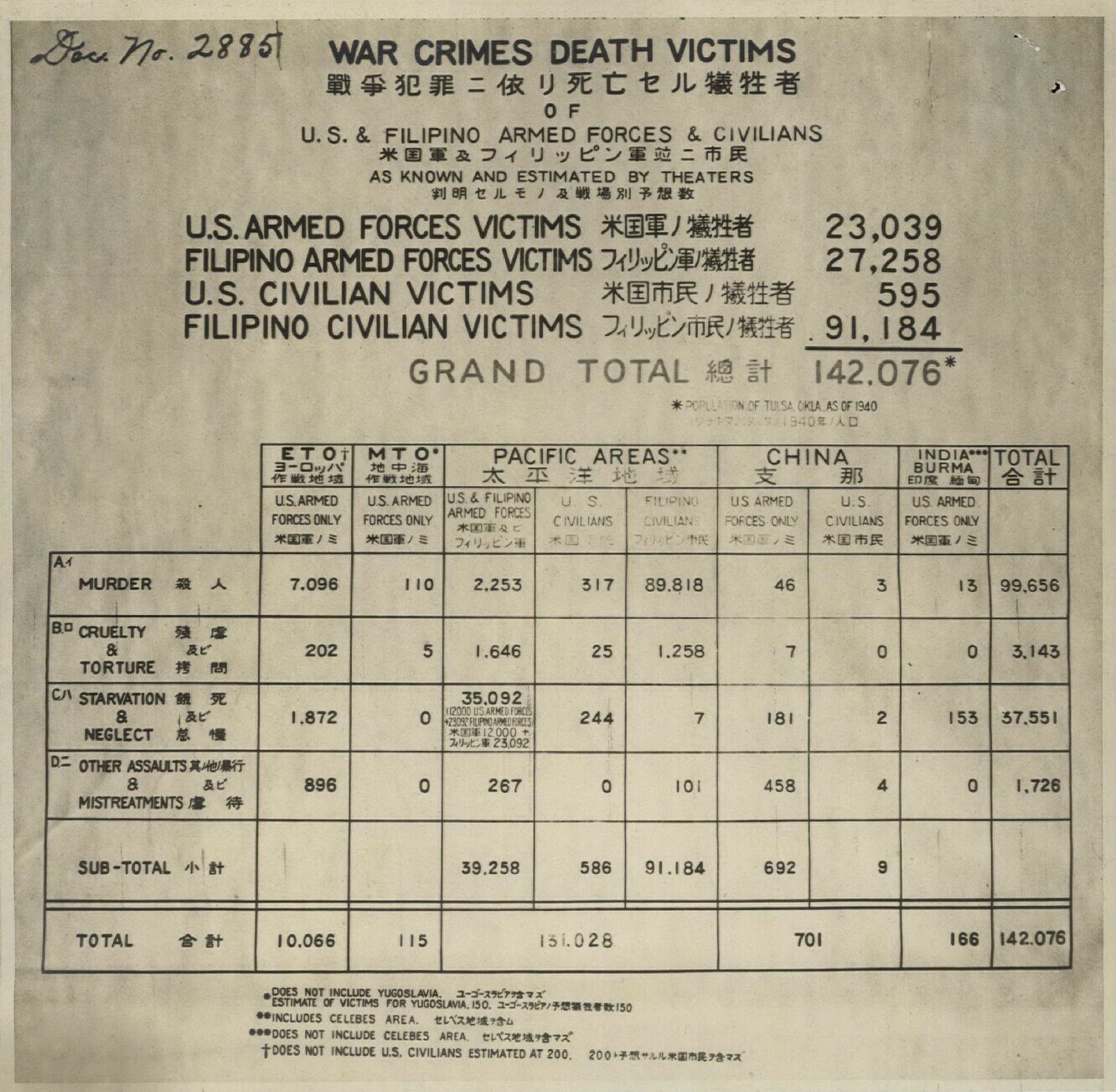
Total Allied Military Personnel as POWs of Japan
Exact figures vary slightly across historical sources due to incomplete Japanese records, losses during transfers (e.g., hell ships), and differing classifications of “Western” vs. non-Western Allies. The most consistent and widely cited estimates for Western Allied military POWs (primarily American, British Commonwealth, Dutch, and Australian) are around 132,000 to 140,000.
Breakdown by nationality:
- Americans: Approximately 27,000–36,000 (including those captured in the Philippines, Guam, Wake Island, and elsewhere; about 12,000 from Bataan/Corregidor alone).
- British and Commonwealth (including British, Australian, Indian, Canadian, New Zealand): Over 50,000 British; 22,000 Australians; estimates for the group total around 80,000–100,000 (many from the fall of Singapore and Malaya).
- Dutch: Around 42,000 military personnel from the Royal Netherlands East Indies Army (KNIL) and navy.
- Smaller numbers of other Allies (e.g., a few thousand mixed in camps).
Non-Western Allies: Additionally, tens of thousands of Filipinos (primarily ~66,000 from Bataan, though many were released or died early) and Indians were captured, but treatment and classification often differed; total POWs including these could exceed 200,000–350,000.
Of these Western military POWs, the death rate was extraordinarily high: 27–34% (compared to ~4% for Allied POWs held by Germany/Italy), resulting in ~35,000–50,000 deaths from starvation, disease, forced labor, executions, and sinkings of transport ships.
Total Allied Civilians as Internees
Approximately 130,000 Western Allied civilians (primarily European and American residents in occupied territories) were interned by the Japanese in civilian camps across Southeast Asia, the Pacific, and Japan itself.
Breakdown:
- Dutch civilians (from the Dutch East Indies/Indonesia): The largest group, estimated at 100,000–110,000 (including women and children; many Eurasian/Indo-Dutch).
- Americans: Nearly 14,000 (mostly in the Philippines, e.g., Santo Tomas camp).
- British and others: Around 20,000–30,000 (including from Singapore, Hong Kong, and Malaya).
Conditions for civilians were harsh but generally less severe than for military POWs (less forced labor on projects like the Burma-Thailand Railway), with death rates of 10–30% depending on location (highest in Indonesia/Sumatra camps), totaling ~13,000–30,000 deaths.
These figures exclude local Asian civilians subjected to forced labor or massacres, as the query focuses on Allied (primarily Western) personnel and civilians. No single “exact” total exists due to wartime chaos and record destruction, but ~135,000 military POWs and ~130,000 civilian internees (total ~265,000) represent the consensus from postwar trials, Red Cross reports, and historians like Yuki Tanaka and the Australian War Memorial.
For further data on “the numbers,” see POW Statistics.