
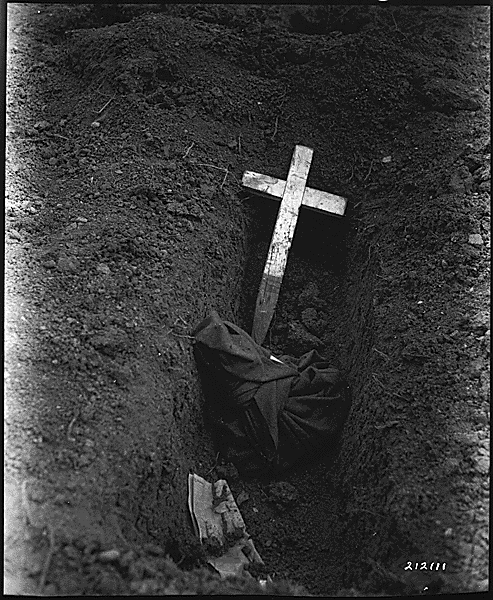
Malnutrition and Disease Among Allied POWs in Japanese Camps
Allied prisoners of war (POWs) held by Japanese forces during World War II endured catastrophic health crises, predominantly driven by severe malnutrition stemming from inadequate rations, unsanitary conditions, and relentless forced labor. These factors created a perfect storm for widespread illnesses, resulting in death rates far exceeding those in other theaters of the war—an average of 35% for Western Allied POWs, compared to just 4% for those held by Germany and Italy. For prisoners of the Japanese, it was deadlier to be their captives than to fight against them in battle.
Of the roughly 140,000 Western Allied military POWs captured, an estimated 35,000 to 50,000 perished, with malnutrition and its associated diseases accounting for the majority of fatalities. Among the 130,000 Allied civilian internees, there were approx. 15,000 deaths. The Japanese military’s cultural disdain for surrender, coupled with logistical strains and deliberate neglect, meant that POWs were often viewed not as protected captives but as expendable labor.
Rations typically consisted of meager portions of poor-quality rice (sometimes as little as 4 ounces or 113 grams per day), watery vegetables, and occasional scraps of fish or meat, providing far below the 2,000-3,000 calories needed daily, especially under grueling work conditions. This chronic undernourishment led to rapid weight loss—prisoners often dropping from over 140 pounds (64 kg) to as low as 42-56 pounds (19-25 kg)—weakening immune systems and making bodies susceptible to opportunistic infections. Overcrowded barracks, lack of clean water, open latrines breeding flies, and exposure to tropical climates further amplified disease transmission, turning camps into breeding grounds for epidemics.
Specific Diseases Stemming from Malnutrition
The predominant illnesses afflicting POWs were directly linked to nutritional deficiencies, which deprived the body of essential vitamins and proteins. Beri-beri, caused by thiamine (vitamin B1) deficiency, was rampant, manifesting in symptoms like edema (swelling from fluid retention), nerve damage, paralysis, heart failure, and night blindness. In camps like Batu Lintang in Borneo, beri-beri rendered up to 600 out of 1,000 men unfit for work by January 1943, with prisoners experiencing dizziness, weakness, and amenorrhea in women internees. Pellagra, resulting from niacin (vitamin B3) shortage, caused skin rashes, diarrhea, dementia, and death, while scurvy from vitamin C deficiency led to bleeding gums, joint pain, and slow-healing wounds. Dysentery, often bacterial or amoebic, thrived in unsanitary environments and was worsened by malnutrition’s impact on gut health, leading to severe dehydration and organ failure; death rates from dysentery alone reached 35% in some Philippine camps due to untreated infections.
Tropical diseases compounded these issues: malaria, spread by mosquitoes in jungle camps, caused recurring fevers, chills, and anemia, with inadequate quinine supplies allowing outbreaks to decimate populations. Dengue fever, diphtheria (leading to secondary tropical ulcers that could expose bone), pneumonia, tuberculosis, scabies, and septic sores from insect bites were also prevalent, often turning minor injuries into life-threatening infections due to weakened bodies. Forced labor exacerbated vulnerabilities; on projects like the Burma-Thailand “Death Railway,” prisoners worked 10-18 hours daily in monsoons, with malnutrition causing exhaustion that invited accidents and infections like ulcers from untreated cuts. During hell ship transports, overcrowding and filth accelerated diseases like dysentery and dehydration, killing thousands en route.
Abnormally High Death Rates
The death toll was staggering, with malnutrition as the root cause in most cases. In the Philippines, at Camp O’Donnell following the Bataan Death March, over 2,200 Americans and 20,000 Filipinos died within months from malaria, dysentery, and starvation, with daily deaths peaking at hundreds and an overall 25% mortality rate in the early period. At Batu Lintang, more than two-thirds of 2,000 British POWs perished, with 600 deaths directly from malnutrition-related invalidity. On the Death Railway, out of over 60,000 Allied POWs, some 13,000 died, including 80,000~100,000 Asians (out of approx. 200,000), primarily from disease and starvation. Overall, U.S. POWs suffered a 40% death rate (11,107 of 27,465), seven times higher than in Europe, with similar patterns for British and Commonwealth forces (nearly 25% mortality). Civilian internees fared similarly, with 11-29% death rates among 14,000 Americans, driven by the same deprivations. These figures were abnormally high because malnutrition not only caused direct fatalities (e.g., heart failure from beri-beri) but also rendered prisoners unable to fight off treatable infections, turning camps into death traps.
The Role of Withheld Red Cross Packages in Averting Illnesses and Deaths
A tragic irony was that much of this suffering was preventable through Red Cross packages, which were systematically withheld, looted, or delayed by Japanese authorities, violating international norms. These parcels contained nutrient-rich foods (e.g., canned meats, cheese, chocolate, powdered milk, sardines, crackers) to combat deficiencies, as well as medicines like quinine for malaria, sulfa drugs for infections, vitamins for beri-beri and pellagra, and antiseptics for wounds. The American National Red Cross shipped thousands of such parcels via neutral vessels, but distribution was obstructed; many POWs received only one package over 3.5 years, far below the weekly allowance under the Geneva Convention. In Davao Penal Colony (Philippines), packages arrived in June 1942 but were withheld for seven months until early 1943, during which prisoners starved; even after distribution (two boxes and 15 cans per person), Japanese guards discontinued vegetable rations, prolonging deprivation. At Batu Lintang, only one partial shipment in March 1944 provided a single tin per person, denying sustained relief for 3,000 inmates. Packages were often diverted to Japanese troops, sold on black markets, or stored unused, as in Cabanatuan and other Philippine camps.
Proper and timely access could have averted countless illnesses and deaths by supplementing calories (boosting from 1,500-1,600 to survival levels), providing vitamins to prevent beri-beri and pellagra, and supplying drugs like quinine (for malaria outbreaks) and sulfa (reducing dysentery mortality). For instance, at O’Donnell, where from 10 April 1942 to 5 May 1942 (6 weeks), nearly 1600 Americans and 26,768 Filipinos died; early distribution might have halved fatalities by addressing vitamin shortages and infections. On the Death Railway, where 13,000-16,000 POWs and over 90,000 Asian laborers “romusha” perished, parcels could have mitigated starvation during “speedo” rushes, preventing exhaustion-related diseases. Postwar accounts and trials confirmed that withheld aid directly inflated death rates, as even sporadic distributions (e.g., in 1943 Philippines) temporarily lowered mortality from hundreds to about 10 per day. Ultimately, the deliberate denial of these resources turned preventable health crises into mass fatalities, underscoring the preventable nature of much POW suffering.
What has been attributed to the Bataan Death March is actually a photo of one of the burial details at Philippines POW Camp #4 O’Donnell. The caption originally read:
“This picture, captured from the Japanese, shows American prisoners, using improvised litters to carry those of their comrades who, from lack of food or water on the march from Bataan, fell along the road. 752897.”
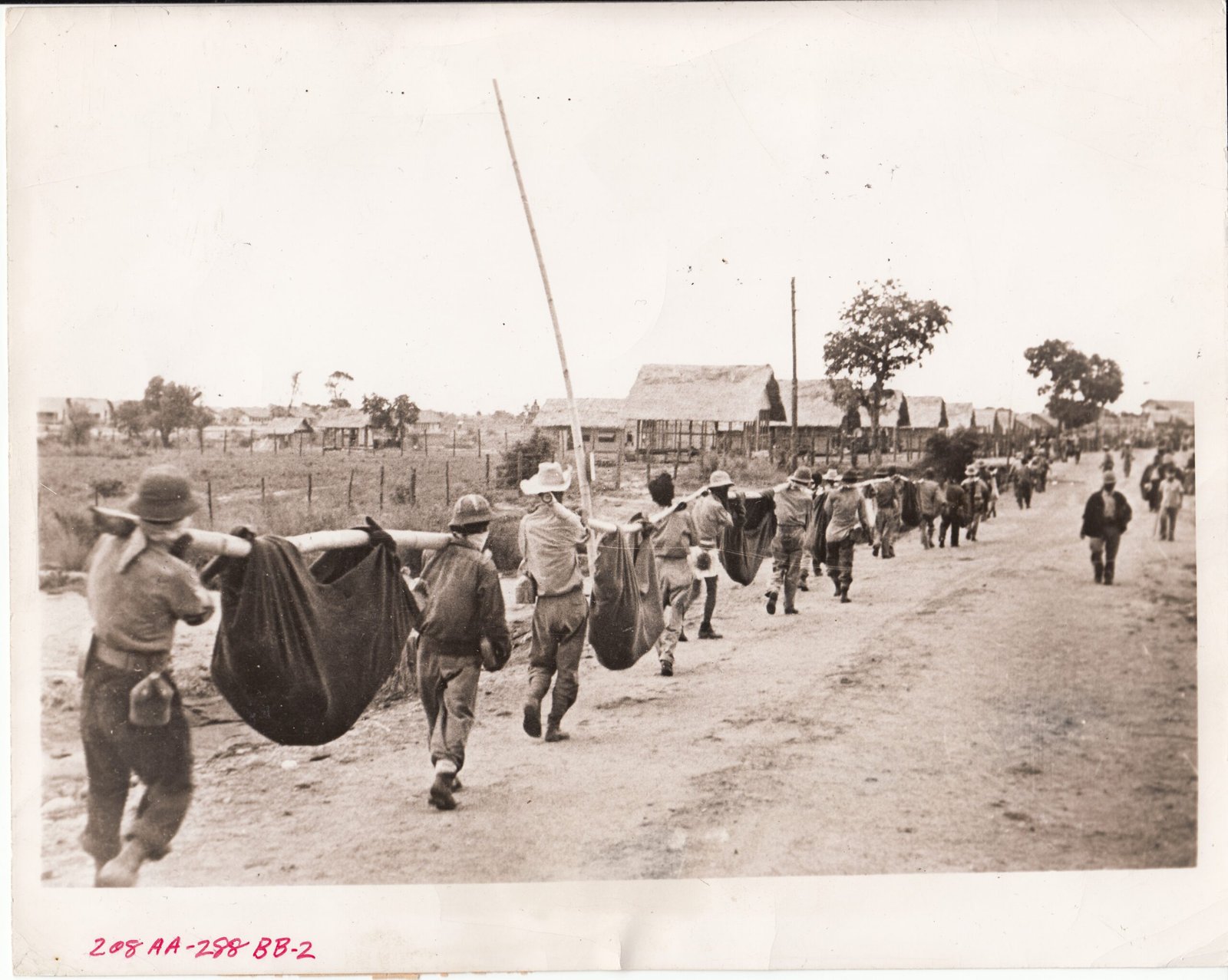
Frank Blazich, during his research on POWs, added this explanation to the photo caption:
“According to Colonel Melvin H. Rosen (U.S. Army Ret.), this photo (208-AA-288-BB-2) is not a photograph taken during the Bataan Death March, but rather a photograph of a burial detail at Camp O’Donnell, the terminus of the ‘Death March.’ Mr. Rosen is one of the survivors of the ‘Death March’ and remembers clearly that burial details were common at the camp. As a further indication that this is a burial detail, he pointed out that if you look closely at the faces of the first two individuals carrying the improvised litters, you can clearly see that each one has a white ‘mask’ over his nose and mouth.”
More on these burial details can be found in these excerpts:
Thomas was to be buried in the O’Donnell cemetery located just outside the camp fence. The story of the burial details at Camp O’Donnell were to become one of the most tragic of all the horrible events of that summer of 1942. Each day the bodies were collected throughout the camp and placed under the Zero Ward building to await burial by the men assigned to this dreadful task. They were then placed on a stretcher and carried out the back gate to the cemetery, to be “stacked like cordwood” until their fellow prisoners could dig a long shallow pit and place them side by side, 10 to a grave. This was a very physical process, and often the men would have to stop digging to rest. They were never quite able to keep up with the demand, for the sick men were dying faster than they could be buried. Late May or early June was when the monsoon rains would generally start, and thus the burial pits would quickly fill with water, making this task extremely difficult for the weakened men who were trying to bury their comrades. — Jimmie Brock Profile Book
Death Becomes an Everyday Occurrence
One of the first formations we saw, as we were marching into O’Donnell, was a funeral detail of men with picks and shovels carrying crude litters of dead as they moved slowly, under Nip guard, toward the burial ground. We were to see the same sight each day during our stay there, but I am sad to say that the size of the parties and the number of litters were always on the increase. — O’Donnel and Cabanatuan
The following morning we were again herded out on the road and retraced our steps 5 kilometers to another Philippine Army camp site, which was then known as Philippine Prison Camp #1 [Cabanatuan]. It was on 1 June that we arrived at this camp, and this is the date of organization of the camp. The water supply here was also inadequate and we were forced to line up to fill canteens, sometimes remaining in line as long as two to three hours to get a canteen of water. We were issued small quantities of rice in bulk and this was cooked by the individual organizations which were set up. Our unit, what remained of the original Bataan General Hospital #2 group, remained together.
The day after our arrival at this camp the first deaths began to occur. Most of these were due to malaria, dysentery and exhaustion. We persuaded the Japanese to designate an area at the south end of camp as a cemetery, and we carried the bodies to this area for burial. It was difficult to get volunteers to carry these bodies because everyone was too weak to undertake the burden. As a result, the bodies frequently lay around the different areas of camp where they died until the stench became troublesome before they were moved. About one week after our arrival at Camp #1, truck loads of American survivors from Camp O’Donnell, which had been the destination point for the Death March, began to arrive. These people were in a much more deplorable condition than the group already at Camp #1. Each truck load (about 40 prisoners were loaded to each truck) would bring in several dead who died on the trip. — Jack Schwartz Deposition


“Never in the history of warfare have men of the medical profession been required to carry out their duties under more trying and disheartening circumstances… and over such a protracted period.” — From Medical Report, Philippines and Japan, 1941~1942 by Col. Wibb Cooper
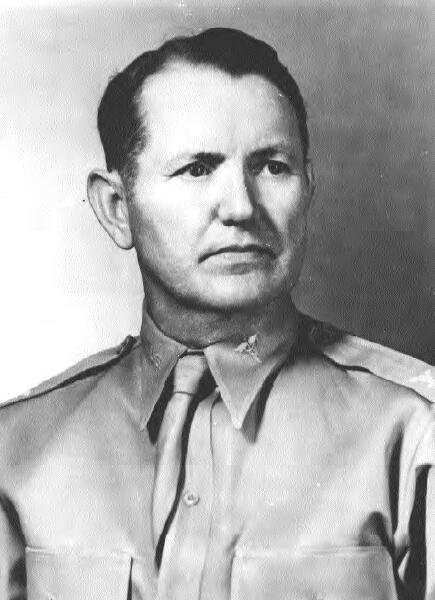
As the head of the U.S. Army Medical Department in the Philippines at the outbreak of the War with Japan, I feel it is my duty and responsibility to make a report to higher authority on the activities of the Medical Department during the period of my responsibility.
This is necessarily a narrative report, largely from memory, assisted by Medical officers who held key positions in the Medical organization during the brief initial campaign in the Philippines.
Several other officers who held important positions and who would have been selected to assist in this report died either during the War or during captivity and their records were captured or destroyed. Some records were recovered on the recapture of the Philippines and I feel confident that a prolonged study and evaluation of the data from these sources should and will eventually be made. I believe a record of achievement was made by our group to which we can all look back with pride and confidence that our contribution to the war effort under the most trying circumstances measured up to the best traditions of the Medical Department.
I wish to give a balanced credit of achievement to the entire Medical Department both during the Philippine Campaign and including the prisoner of war phase. The Japanese authorities selected certain medical personnel for medical work at the various camps arbitrarily at times. It was a matter taken entirely out of the hands of the senior Medical officers present and just as in other matters of camp administration, the senior line officers had no rank and found themselves doing farm work assigned to them by squad leaders, their juniors in rank, just so the senior Medical officers were given no prerogatives or authority in accordance with their rank.
I know of no group of Medical officers who ever lived through such a trying experience as that capable group of medical prisoners of war trying to practiced medicine under the supervision of ignorant Japanese soldiers in most cases, with practically no medical supplies and equipment — and they themselves often suffering from the same debilitating ailments they were attempting, often unsuccessfully, to treat in their fellow prisoners of war.
I feel confident that very soon there should be available for publication in our various medical journals articles by these Medical offices filled with firsthand knowledge obtained from the real “crucible of experience.” These doctors practiced medicine under the most difficult circumstances possible and observations made, especially in the deficiency diseases, should be of permanent value. Malaria, the dysenteries, and deficiency diseases were our main problems, both during and following the siege of Bataan and Corregidor.
…..
The prisoners arrived in Bilibid during the afternoon of May 25th. There were now about 12,000 prisoners here, in a place designed to accommodate 4,000 at the most. Each day a large group of the prisoners was evacuated to Cabanatuan prison camp in northern Luzon, where they were later joined by the surviving Americans from Camp O’Donnell.
There were several reasons for the bad treatment accorded to these prisoners. For one thing, there was the barrier of language. Very few Americans had any knowledge of the Japanese language, and as a result they frequently brought down punishment on their heads through unwitting and unintentional disobedience of orders that they did not understand. In other cases the treatment was due to the policy of indifference exercised by the local Japanese commander, and in many other instances, it was quite plainly a matter of revenge.
…..
In August 1942, it was announced by the Japanese Military that from that time on these captives would have the official status of prisoners of war. As a matter of fact, though, this announcement made little change in the conditions under which the prisoners lived. Camp commanders and their subordinate officers paid scant attention to their charges, being for the most part content to leave the responsibility for their supervision and care in the hands of privates and noncommissioned officers. These men, many of them uneducated and uncouth, and most of them brutal, gave the prisoners their orders, and made whatever arrangements were put into force for the prisoners welfare.
…..
In closing this report covering the march from Bataan, I would like to pay tribute to the loyalty of the majority of the Filipinos encountered along the route of march. They were ready and anxious to help out in whatever small way they could, but the order of the day seemed to be that they were not to approach the road as the column was passing by. Some did so, apparently at some risk to their own personal safety. Others would stand at a safe distance and through sugar cakes and packages of cooked rice and even some packages containing fried chicken into the column as it passed. Only a gesture but one that conveyed a feeling of loyalty that is undoubtedly fixed in the mind of almost every man who made the march.
…..
At the docks in Fukuoka an American medical officer was called upon to see an officer who was in a dying condition from pneumonia. The Japanese doctor there gave the Medical officer medicine for him and some morphine to ease his pain. Before the officer died that night he was asked whether he had been forced to come on this move or had come by choice. His reply was that the Japs would not authorize him to remain in Fukuoka. This is a typical instance of how men were moved from place to place when it was evident that they were in no condition to survive the move. I do not recall ever making an overnight move from Bataan to Korea when some dead were not left somewhere along the route.
The Japanese doctor who gave the medicine at the docks in Fukuoka turned out to be the one from Mukden of whom so many good things have been reported. Ironically enough he was not taken prisoner by the American forces but was in the zone occupied by our Allies.
…..
The Japanese doctor at this camp [Jinsen, Korea] displayed an absolute lack of interest in the medical problem faced by this group of prisoners and, on the contrary, seemed to be possessed with a fiendish desire to abuse and mistreat them. He was the most feared Jap in the camp and rarely did his turn as Officer of the Day go by without someone getting a severe beating. The mortality at this camp was low — only two Americans were buried there after our arrival.
On the day following the surrender, the Japanese authorities notified us that the War was over and all work details were discontinued. We were asked to remain within the compound or to take a Japanese guard with us if we desired to leave. Native merchants were permitted to bring foodstuffs into camp after the first three or four days, and soon we were eating eggs and beef and fresh fruits of various kinds, as well as all the Irish potatoes that we cared to eat. Weight gain was almost unbelievable. I personally gained six kilos in six days. Of course, most of this was due to fluid retention in the tissues as well as to filling up a GI tract that had been empty for something over three and one-half years.
A few days later, the B-29s came over and started dropping barrels of American canned foods, cigarettes, chewing gum, candy, clothing and medical supplies. It was a thrilling day and almost ended in disaster when some of the barrels broke loose from their parachutes and came crashing down through the roof tops. They couldn’t have hit a safer spot since all the prisoners were outside watching the show. There was one casualty, a fractured femur, but no fatalities. When this demonstration was over, someone was heard to remark: “They are killing us with kindness.” I failed to hear anyone criticizing the procedure and when they returned next day, everyone got outside the compound and watched the show from a safer viewpoint.
Parachute materials of red, white and blue were salvaged and that night a group of our most expert needle men manufactured what is believed was the first American flag to be raised in Korea after the surrender of Japan. She was still flying from her bamboo flagpole inside the prison compound when the Americans landed at Jinsen September 8, 1945.
It is good to be free!
See full report: Medical Report: Philippines & Japan, 1941~1942 by Col. Wibb Cooper, Medical Corps
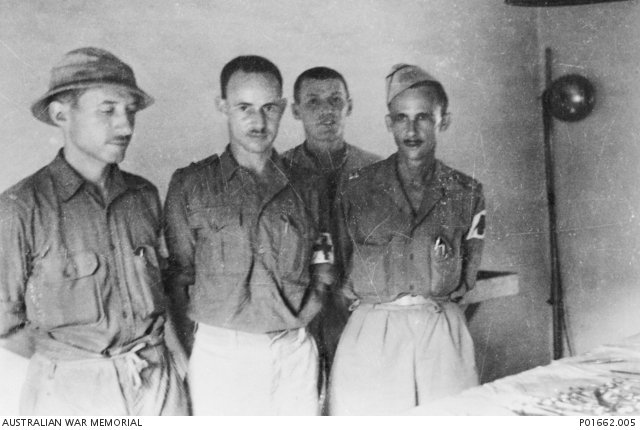
Excerpt from:
The Hewlett ReportFUKUOKA #17, OMUTA, JAPAN
“DAI JU NANA BUNSHO [CAMP #17]
NIGHTMARE REVISITED”
Dec. 1978
by THOMAS H. HEWLETT,
M.D., F.A.C.S., COL. U.S.A. (Ret)
PSYCHOLOGIC AND SOCIAL PROBLEMS: I am troubled that the V.A. can recognize a broad range of psychologic and social problems in our current society, and not be cognizant of the fact that some of the patterns they encounter in former P.O.W.’s are long term results in individuals who had no help available when the emotional or psychic traumas occurred during long confinement. The philosophy of the prisoner of war is a strange one, individually developed to make survival possible in the most hostile environment. He first learned to laugh at the tragedies that comprised the every day life. He completely obliterated the pangs of hunger. The starving man would willingly trade his meager ration for a few cigarettes. In many instances he would risk his rations gambling with professionals who pursued their trade without compassion for any life except their own.
The language problem was ever present. Interpreters, either Japanese- or English-speaking, tended to put themselves in a command position so they created an atmosphere of distrust.
One prisoner of the A detail was executed for attempting to learn to read Japanese. He was utilized as the target for a bayonet drill by the guard detail. His body when examined showed over 75 stab wounds.
Early in the course of starvation hunger is overwhelming and the theft of food by such a person is not a criminal act. The Greek “Pavlokos” was starved to death in the guardhouse for stealing food. It took them 62 days to accomplish this execution; benefit of trial was denied.
For a minor infraction of rules a 19-year-old Australian soldier named David Runge, was forced to kneel in front of the guard house for 36 hours. During the period he developed gangrene of both feet; bilateral amputation was carried out 10 March 1945. He was carried on the backs of comrades to keep us reminded of the benevolence of the Japanese. Runge has only recently retired from an active life.
In camp the prisoners’ life was subject to the individual whims of the guard on duty. The prisoner could be aroused from rest to undergo punishment or humiliation, whichever met the sadistic needs of the guard.
Underground the prisoner was faced with falling walls and ceilings, blast injuries and entombment. He lived each day with the possibility of sudden death or permanent disabling injury.
…..
What has just been presented to you is not documented elsewhere in the medical annals of this country, the proverbial land of plenty. Certainly no human would knowingly submit to a controlled laboratory study aimed at duplicating this experience. I believe, along with Dr. Jacobs, that we survivors still face disabling physical and emotional problems which can be traced to our experience. Medical computers and the young physicians of the V.A. are, I believe, completely confused when called upon to evaluate our problems. Medicine is not an exact science — it has chosen to deem the profession an art and a science. Our hope must then lie with those physicians who evidence art in dealing with the whole patient.
There is no summary to a nightmare that was permanently tattooed in our brains, but that is how it was for those who were “expended”…..

Delving into archival material with intensity... and sharing it with the world
japanpow(at)use.startmail.com
Copyright 2001-2026, Wes Injerd. All Rights Reserved.