| Changi POW Camp Research Help |
|||||||||||||||
|
Main Index Main Camp List |
|||||||||||||||
British and Dutch rosters: (archival documents, PDF)
British (RG 407 Box 117) - Vol. 1; British Officers A~Z and Other Ranks A~E (a - b)
British (RG 407 Box 118) - Vol. 2; British Other Ranks F~N British (RG 407 Box 118) - Vol. 3; British Other Ranks O~Z and Civilians A~Z Dutch (RG 407 Box 118) - Vol. 4; Dutch Officers A~Z and Other Ranks A~K Dutch (RG 407 Box 119) - Vol. 5; Dutch Other Ranks L~Z and Civilians A~Z Australian (RG 407 Box 120) - Vol. 6; Australian Officers A~Z and Other Ranks A~J Australian, American, Italian, Others (RG 407 Box 120) - Vols. 7 and 8; Australian Other Ranks K~Z; American Officers, Other Ranks, Civilians; Italian Officers and Other Ranks; Danish and Norwegian Civilians Civilian Internee Camps in Asia and Japan (RG 389 Box 2201) - Changi and Malaya camps; includes list of internee camps in Asia and Japan NOTE re Page 7, courtesy of Nadia Wright: "The American
lists include Armenians. These Armenians were born in Singapore or else
were naturalised British subjects: Desiree Hacobian, Rispy Hacobian,
Looleen Martin, Mary Martin,Mavis Seth."
Percy Armstrong Collection (courtesy of grandson, Martin Armstrong) Percy Armstrong, Gunner, 1831416, 89 Bty., 35 Lt. A.A. Regt., Royal Artillery
Interned at Batavia, died on 18 November 1942 on board the Singapore (Shonan) Maru enroute to Japan, buried at sea From Armstrong's Index Card (Individual Record Card): DATA ON A Prisoner of War
-------------------SURNAME Armstrong Initial Percy Rank Gnr Service No 1831416 Nationality British DoB 04.03.05 Sex M Profession Clerk Initial Camp Java PoW Number 2425 Died 18.11.42 Regiment RA NoK/Address wife Helen D Arm'g 1 Hayes Cl Stopsley Beds Born 0 Other Camps 0 From Java Interned 08.03.42 Freed 02.09.45 Remarks 1 0 Remarks 2 0 Remarks 3 0 Buried 0 Authority 1 WO392 Authority 2 WO345 1942.10.21 Transferred to mainland 1942.11.18 1500 hours Died on board the Shonan Maru (Malaya) due to weakness from diarrhea 1942.11.18 1830 hours Buried at sea at N. 23°34' E. 119°46' Notes: He was captured at Garoet and either trucked walked or railwayed to Batavia. He was then transported by ship to the Malai holding Camp in tents on NE tip of Singapore Island. He was them shipped on the Singapore Maru, sailing on 30th Oct 42. Initially it anchored at Cape St Jacques near Saigon, reached Takao Formosa(Taiwan) in mid-November where numerous bodies were removed for cremation, other bodies had been buried at sea. There were numerous deaths due to malnutrition and dysentery. The ship was not sunk and arrived in Moji on 25NOV42. Further notes by Martin Armstrong: The camps I need this information on, are the following:
a) The India Barracks, 1934 (when the India Barracks were built), two barrack blocks and several huts of the India Barracks. I think as far as I know this was built by the British Army in the 1930s, and housed Indian soldiers, who served in the British Army, and then later on, the barracks held Dutch and British RAF who were captured by the Japanese in 1942 and held in tents near the Indian Barracks. These tents were known as the Java Lines, according to the source:- Carol Cooper's article entitled 'THE STORY OF CHANGI' http://www.cofepow.org.uk/pages/asia_singapore_changi_story.htm' Many Dutch and RAF prisoners taken in Java and later sent to Singapore were housed in tents close to the India Barracks and this area was known as the Java Lines.' My Granddad: Percy Armstrong,was also captured in the Battle of Java 1942, on 8th March. He was a Gunner in the 89th Battery, 35th Light Anti-Aircraft Regiment, The Royal Regiment of Artillery (R.A.). He was imprisoned at Batavia main camp for about 7-8 months as far as I can calculate and then shipped to Singapore on 21/10/42, the 'Malai' group of camps and with his fellow captives, were held in tents there, until they were shipped to Japan on 30/10/42 onboard the Singapore Maru. My Granndad was one of the those who did not survive the journey to Moji, Japan. He died at sea during the voyage. I am looking for the name of the ship that shipped him from Batavia to Singapore. And the actual port in Singapore he arrived at.. was it Keppel Harbour or Serangoon or another one? I think according to one source that I have is that he could have been on the No.1. Yoshida Maru from Batavia to Singapore, but I need that to be confirmed by authentic documentation, because it appears it left Batavia port on the 22/10/42. I would like to find out where in the Changi camps, were these actual tents situated. Did anyone take photos of the tent lines? Were these tents the ones that were called the Java lines, that I previously mention were according to Carol Cooper's account were near the Indian Barracks at Changi, where the RAF and Dutch POWs were held too? Or were they a separate line of tents? Could it be possible, that my Granddad was held, temporarily in this group of tents? b) The Roberts Barrracks (I understand now, that part of the barracks was used as a hospital, during WW2) and Kitchener Barracks. Attached are files about the complex I have so far, but I haven't really got a good map of the whole Changi complex in WW2, only sketch maps really... but even after trying to use the zoom feature in Microsoft Word, it didn't help to make it any clearer on the sketch maps. You see I am really looking for the tents line where I think my Granddad spent about 4 to 5 days in, in temporary transit at Changi, before being shipped out on the Singapore Maru, from Singapore. I have some photos of what is called the Commando Barracks stands on the Fairy Point Hill near Andover Road in the same 'Changi' file, pages 26-31. I am thinking that this must be the Kitchener barracks? 'Between 1934 (when the India Barracks were built) and 1941 the work continued in earnest and by 1936 most of the barracks, married quarters and officers mess were completed. The Royal Engineers took over the Kitchener Barracks and the Royal Artillery Coast Artillery Regiment occupied the Roberts Barracks as more barracks and quarters continued to be built.' 'The British and Dutch were housed at Roberts Barracks, Kitchener Barracks and the wooden barracks at India Lines. Part of Roberts Barracks was used as the hospital.' Citation: Both extracts are from THE STORY OF CHANGI by Carol Cooper http://www.cofepow.org.uk/pages/asia_singapore_changi_story.htm I don't know if you might find them useful but I've got some files on the No. 1 Yoshida Maru and the Singapore Maru. I thought I would just send them, just in case anyone wants them. The following suggestion was forwarded by the eminent British researcher, historian, and author, Jonathan Moffett. Relatives of British POWs who
were in Changi POW Camp, Singapore may like to know that the Public
Records Office in Kew, London - a short distance from the Gardens and
tube station - hold some 58,000 POW index cards in 50 or so boxes.
These contain basic details of each POW and in Japanese on the back
additional information - that on POWs who died is particularly
informative.
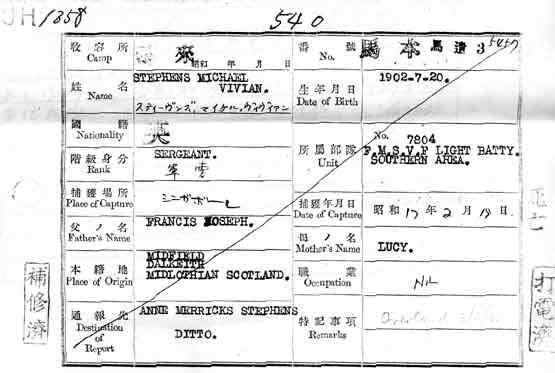
The cards can be photocopied for a fee or digitally photographed. Look at the Public Records Office website http://www.pro.gov.uk and its PROCAT catalogue to plan your visit. Click here to see sample of card What you are after in this case is file WO 345. Key in on the catalogue search WO 345 / 1 to see box I which contains names alphabetically Aaron to Angus, WO 345 / 2 etc. The PRO is very user friendly with helpful staff. If you are a first-time visitor you get a short induction tour. If you can't visit you can hire private researchers to do the job for you. Relatives of British Malayan civilian internees can, by appointment, visit the Imperial War Museum Reading Room to view similar details of Changi Gaol internees in the Changi Register and view other short details in the 1940 Malayan Directory. Artwork from Changi POW Camp - The Artwork of Des Bettany "Dad
was at Towner Rd and spent 2 years in Changi Gaol. He always told us he
had to paint to keep sane, most of these being cartoons that also kept
his mates spirits up. After over 60 years in a cupboard, after dad’s
death we decided to scan and place the over 300 paintings on a
webpage." -- Keith Bettany
|